


Stay Up To Date With Us!
We will never spam you or share your email address.
Game Sound Design Strategies
GSD StrategiesCheck out the gamesounddesign.com strategies when you are feeling creatively uninspired. Each random strategy will present you with a new avenue to pursue. Give them a try!
Game Sound Design Glossary
GSD GlossaryOur game audio glossary has all the sound terms you have been wondering about. Game audio can be confusing enough without having to deal with a new technical language. We are constantly updating the database with new terms that relate to not only game audio but game developer terms as well.
How To: Contact Microphones
Article by George Spanos
Contact microphones can be a great source of new audio inspiration. Whenever I find that I'm getting bored with the same old recording techniques to capture sounds for my library, I will often turn to my trusty contact microphone. Read on to find out more about these little recording wonders and what they can do for your sound design.
What is a Contact Microphone?
A contact microphone functions differently than dynamic, ribbon, and condenser microphones. Though they do function similarly to the microphones mentioned above in that they convert sound pressure waves into electrical energy. Contact mics pick up vibrations from the surface that they are placed on. They then convert the vibrations into a voltage that is passed into an appropriate preamp to boost the signal so that it is at a volume level that is suitable for recording. It is important to use a preamp designed for use with a contact microphone to attain the full frequency spectrum capable of the device.
Basic crude forms of the device are simply a thin piezo electric ceramic material glued to a brass or alloy disc. When purchasing from a dealer contact microphones usually are of better quality and are specifically made for recording. Usually the mic will come preassembled with a cable that will be terminated in an XLR or 1/4" connector for easy use with your mixing board or recording interface. Flexible PVDF fluoropolymer piezo film is also available and can be easier to work with.
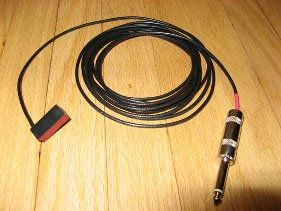
Depending on the type of contact microphone you are using, it will either be wrapped around the object which will be vibrating or it will be stuck onto the object with some sort of adhesive tape or attached via clips. This will allow the vibrations of the object to be picked up by the microphone and recorded. Some contact mics are also sealed so that they may be used in water. You can achieve some surprising results with contact mics in water.
I have been using contact microphones for years and I still get surprised at some of the results that I get out of them. The enormous potential of recording with these miniature devices can be quite gratifying. Recording sounds that would otherwise be non-distinct with traditional microphone techniques suddenly become larger than life or take on a sound characteristic that is brand new.
Doors
The audio example below is of a very thin metal door that is being closed within its metal frame. It is important to note that this door was not made out of a solid sheet of metal but rather, thin strips of metal much like a fence. The sound of this door closing when mic'ed with a traditional condenser microphone setup was unimpressive. It sounded very thin and not really useable. However, the contact mic really picked up on the hard steel vibrations to produce a really interesting sound:
Pipes And Sinks
In this next example I set up a contact mic on a steel pipe in the basement of an old apartment building. I didn't actually know if any water was flowing through this pipe until I put the headphones on to monitor the mic. The rush of water (I hope it was water ;)) was a surprise as I did not think I would get anything useable out of the PVC pipe. There is quite a bit of detail as you can hear the water rushing through it:
For this next sample I taped the contact mic to the underside of my metal kitchen sink. I ran the water with varying intensities and recorded some nice flowing sounds. You can also hear the sound of the water rushing into the supply pipe for the sink, which was nearby. A good contact mic will pick up even the most minute vibrations:
Hard Drives
Computer hard drives can be a very interesting source of clicks and clacks. In addition to the thin clicks that the read/write head produces you can hear the drive wind up as it is powered on and wind down as it is shut off. An externally powered hard drive was used and produced this sound:
Wind
The sound of wind rushing through a crack in a window can also be recorded using a contact mic. This next example was recorded on an extremely windy and cold day. The wind was rushing through a small crack in the window so I attached the contact mic and recorded this sound:
Small Servos
One day while taking a picture with my SLR camera I stumbled upon the idea of recording the automatic focus of the camera lens. The sound was far too quiet to record with traditional means so I attached the contact mic to the camera body. While focusing in and out I managed to record these servo sounds which could be used for any number of applications: